
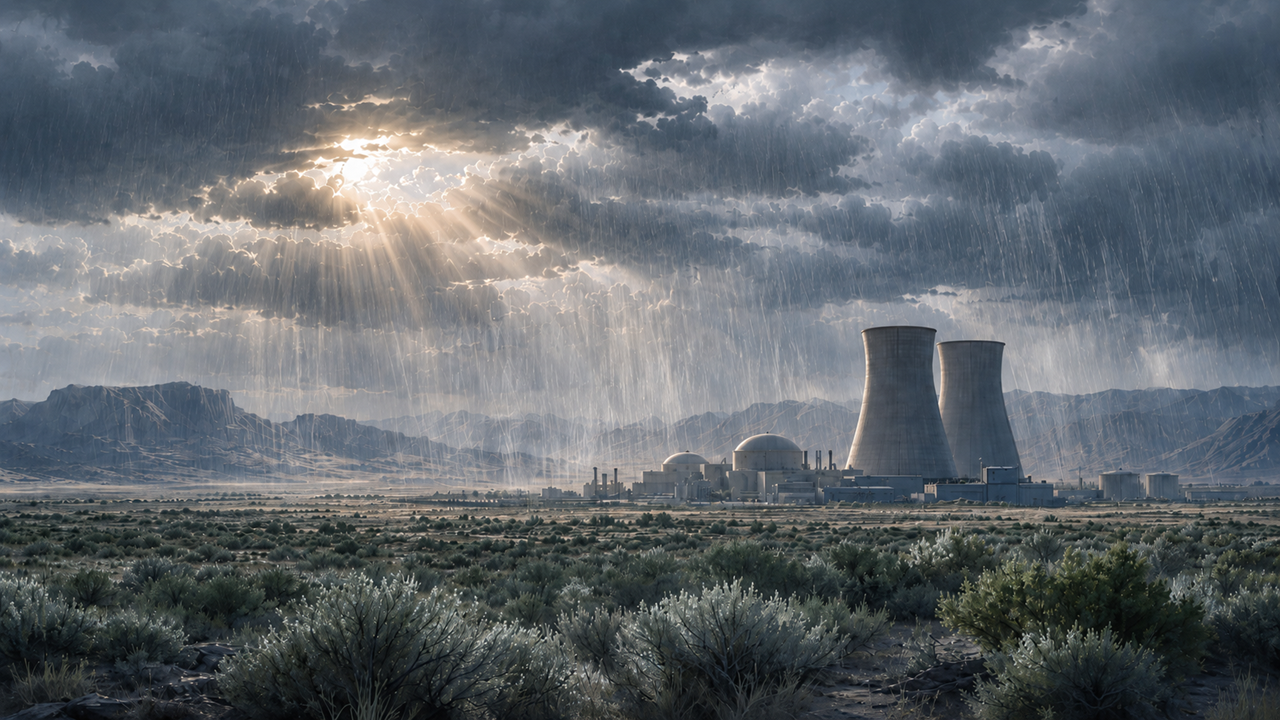
There is a proverb that says "A promise is a cloud; fulfillment is rain." Nuclear just delivered a downpour.
The nuclear industry has spent years making the case for itself. Commissioning dates slipped. Cost estimates widened. Projects that were supposed to prove the model stretched past their budgets and their schedules, leaving the industry to argue on the strength of what it intended, with the delivery still pending. That argument gets harder to sustain every year the delivery is overdue. What ends it is performance. This week the performance arrived, spread across demonstration programs, fuel supply chains, regulatory frameworks, construction sites, and an application nobody had formally put on the table. The signals this week describe an industry that finally caught up to its own ambitions.
The work that bold claims set in motion does not come back all at once. It comes back in pieces, from different programs, different countries, and different stages of the development chain, each one the end of a timeline that started years earlier. This week the returns arrived. We start with the program that moved fastest.
On July 2, Deployable Energy's Unity reactor achieved initial criticality at the National Reactor Innovation Center at Idaho National Laboratory, completing the US government's goal of three advanced reactor criticalities before July 4. The program arc that started with Antares in early June and continued with Valar on June 18 closed two days before its deadline. Unity operated under a different authorization pathway than the first two reactors. Antares and Valar ran under the DOE Reactor Pilot Program. Unity was the first selection under the Nuclear Energy Launch Pad, a newer INL-based initiative that uses DOE authorization to certify and build first-of-kind designs at speed, bypassing the conventional NRC licensing route. From selection to criticality took roughly 150 days. INL Laboratory Director John Wagner called that benchmark remarkable. The reactor itself is a 1 MWe water-moderated, gas-cooled design built for deployment where conventional grid infrastructure is unavailable, including remote communities, defence applications, and industrial sites. Three companies, three reactor designs, three criticalities in 28 days. The program was built to answer one question: whether the US could bring multiple advanced reactor concepts to criticality on a compressed timeline. That question now has a documented answer. [1]
The fuel those advanced reactors will need crossed a different threshold the same week. On June 30, Centrus Energy signed a 900 million dollar fixed-price task order with the Department of Energy, transitioning its HALEU cascade at Piketon, Ohio from government-funded demonstration into private commercial operation. The cascade is the only US-owned, US-technology enrichment plant to have begun production in 70 years. HALEU enriched to up to 19.75 percent U-235 is the fuel of choice for most advanced reactor designs and has been effectively unavailable from Western sources outside Russia. Under the new contract, Centrus must deploy commercial-scale production capacity and deliver 1 metric ton of HALEU by March 2032, with first new capacity expected online by 2029. Centrus is also exploring a joint venture with Oklo to establish HALEU deconversion services, converting hexafluoride into the oxide and metal forms most reactors require, a capability that does not currently exist commercially anywhere. That gap is now closing. The advanced reactor fuel supply chain has its first commercial domestic source, and a path toward the deconversion services that convert enriched material into usable reactor fuel. [2]
While the advanced reactor programs were closing out their demonstrations, the regulatory framework governing everything built next was being rewritten. On July 1, the NRC proposed two rules simultaneously. The first is the most comprehensive update to reactor licensing in decades, spanning every stage of a plant's lifecycle from initial design approval through decommissioning. It introduces flexible, risk-informed approaches, streamlines construction starts, modernizes emergency planning zones, updates siting criteria to accommodate a broader range of technologies, and enables advanced fuels including higher-enriched and accident-tolerant designs. The second rule modernizes radiation protection requirements, replacing the longstanding ALARA principle with clearer, objective compliance standards while leaving existing dose limits unchanged. Both rules advance under the ADVANCE Act of 2024 and Executive Order 14300. The NRC chairman described the licensing rule as stripping out rigid frameworks and unnecessary conservatism. The significance is architectural. The existing rulebook was written for a generation of reactors that no longer defines the frontier. These proposed rules are written for the generation that does. [3]
Across the Atlantic, a different kind of signal arrived. Slovakia began loading fuel into Mochovce unit 4 on June 29, starting active commissioning of a reactor whose construction began in 1986 and stalled six years later. That wait is over. The regulatory authority issued commissioning permission on May 22, confirmed it on June 24 after the appeals period closed, and fuel loading began five days after that. Once it reaches full power, nuclear will supply the equivalent of 77.5 percent of Slovakia's electricity consumption. No country in the world will have a higher nuclear share. The unit is a 471 MW VVER-440, the fourth at the site; its sister unit Mochovce 3 reached commercial operation in October 2023 after its own multi-decade delay. What is notable about this signal is what it required. Completing a reactor stalled since 1992 demanded that every system meet the current regulatory standard, not the standard in force when construction was suspended. The commissioning authority required demonstrated readiness across construction completion, system assembly, inactive and integral testing, fire protection, radiation protection, environmental protection, and personnel qualification before a single fuel assembly moved. A project that began under one generation of engineers and finished under another proved it could meet the standard the industry holds today. [4]
The furthest signal of the week came from the Indira Gandhi Centre for Atomic Research in Kalpakkam, Tamil Nadu, where India inaugurated the world's first operational facility for producing hydrogen using nuclear process heat. The facility integrates research from the Bhabha Atomic Research Centre with IGCAR's fast reactor expertise, using heat from the Fast Breeder Test Reactor to drive a copper-chlorine thermochemical cycle that splits water into hydrogen and oxygen without combustion or electrolysis. The FBTR is a sodium-cooled reactor that first started up in 1985 and reached its nameplate capacity of 40 megawatts thermal in 2022. The copper-chlorine cycle operates at lower temperatures than competing thermochemical routes and achieves higher thermodynamic efficiency as a result. Today, more than 96 percent of the world's hydrogen comes from fossil fuel processes, nearly all of it through steam methane reforming or coal gasification. This facility produces none of its hydrogen that way. None at all. The operational experience it generates will support scaling decisions for a 5 megawatt thermal high-temperature gas-cooled reactor currently in development for hydrogen production at BARC's Vizag campus. Nuclear has been defined by what it generates for the grid. This facility demonstrates that the same physics can serve an entirely different industrial need, and that the transition from research concept to operational reality is shorter than the sector has typically assumed. [5]
Each signal this week ends a chain. The thing each one produces is a verifiable fact about what the industry can do, replacing a projection that asked for the benefit of the doubt.
The India signal earns its own reading. The first four fulfillments are for promises nuclear made and was held to. India's is for something the sector never formally committed to delivering. Process heat for thermochemical hydrogen production was a research program with a long road ahead of it. The IGCAR facility proves the road is shorter than expected. An industry that delivers in applications it never put on the table is describing a capability that outpaces its own stated ambitions.
That is the harder claim to absorb. The sector spent years defending its core promises against skepticism that was, given the available evidence at the time, entirely reasonable for anyone paying attention. This week it met them. The more interesting question is no longer whether nuclear can do what it said. It is what nuclear can do that it has not said yet.
Two of this week's signals have been moving through defined stages across prior editions.
The DOE microreactor program has tracked from the first presidential mandate through three criticalities in 28 days. Antares achieved initial criticality in early June, Valar followed on June 18, and Unity closed the set on July 2. The program ran two concurrent authorization pathways: the DOE Reactor Pilot Program for Antares and Valar, and the newer Nuclear Energy Launch Pad for Unity. The Launch Pad's 150-day selection-to-criticality timeline sets a new execution benchmark for the advanced reactor sector. The program arc is now complete.
The HALEU supply chain has been a tracked signal category since we first identified fuel security as the strategic variable in the advanced reactor build-out. The Centrus cascade's transition from government demonstration to private commercial operation is the most significant gate in that story. The US advanced reactor fleet now has a domestic commercial source for the fuel most of its designs require. That was not true a week ago.
The promises nuclear made over the last decade were large. The skepticism they attracted was reasonable. What changed this week is that several of those promises became documented facts, spread across demonstration, fuel supply, regulation, and construction. The clouds burst.
Nuclear just demonstrated that it can do things it never promised. That raises a different question than the sector is used to asking. What are the applications that nuclear process heat makes possible that have not yet been seriously proposed, and who in this industry is already working on them?
More next week.
Dive deeper
- Criticality for third US reactor ahead of 4 July deadline Deployable Energy's Unity demonstration reactor achieved initial criticality at Idaho National Laboratory on July 2, completing the US government's goal of three advanced reactor criticalities before July 4. Unity operated under the Nuclear Energy Launch Pad, a newer DOE authorization pathway, and reached criticality roughly 150 days after selection, setting a new benchmark for execution speed in the advanced nuclear sector.
- Centrus Signs $900M DOE Contract, Pivots Sole U.S. HALEU Cascade to Commercial Operation Centrus Energy signed a 900 million dollar fixed-price task order with the Department of Energy on June 30, transitioning its Piketon, Ohio HALEU cascade from government demonstration to private commercial operation. The cascade is the only US-owned enrichment plant to have begun production in 70 years. Centrus must deploy commercial-scale HALEU capacity and deliver 1 metric ton of HALEU by March 2032, with first new capacity expected online by 2029.
- NRC Proposes Most Comprehensive Modernization of Reactor Licensing in Decades The NRC proposed two rules on July 1: a sweeping update to reactor licensing covering every lifecycle stage, and a modernization of radiation protection requirements. The licensing rule introduces risk-informed, performance-based approaches, streamlines construction starts, and enables advanced fuels. Both rules advance under the ADVANCE Act of 2024 and Executive Order 14300.
- Fuel loading begins at Slovakia's Mochovce 4 Slovakia began loading fuel into Mochovce unit 4 on June 29, starting active commissioning of a reactor whose construction began in 1986 and stalled in 1992. Once the unit reaches full power, nuclear will supply the equivalent of 77.5 percent of Slovakia's electricity consumption, the highest share for any country in the world.
- India inaugurates nuclear-powered hydrogen production facility India inaugurated the world's first operational facility for producing hydrogen using nuclear process heat at the Indira Gandhi Centre for Atomic Research in Kalpakkam. The facility uses heat from the Fast Breeder Test Reactor to drive a copper-chlorine thermochemical cycle, producing hydrogen without combustion or electrolysis. The operational experience will support scaling decisions for a 5 MWt high-temperature gas-cooled reactor currently in development for hydrogen production.
Process note: This brief is created using an AI-assisted workflow and reviewed before publication. Learn more about Finding Critical Path and how each edition is built at About — FindingCriticalPath.com.