
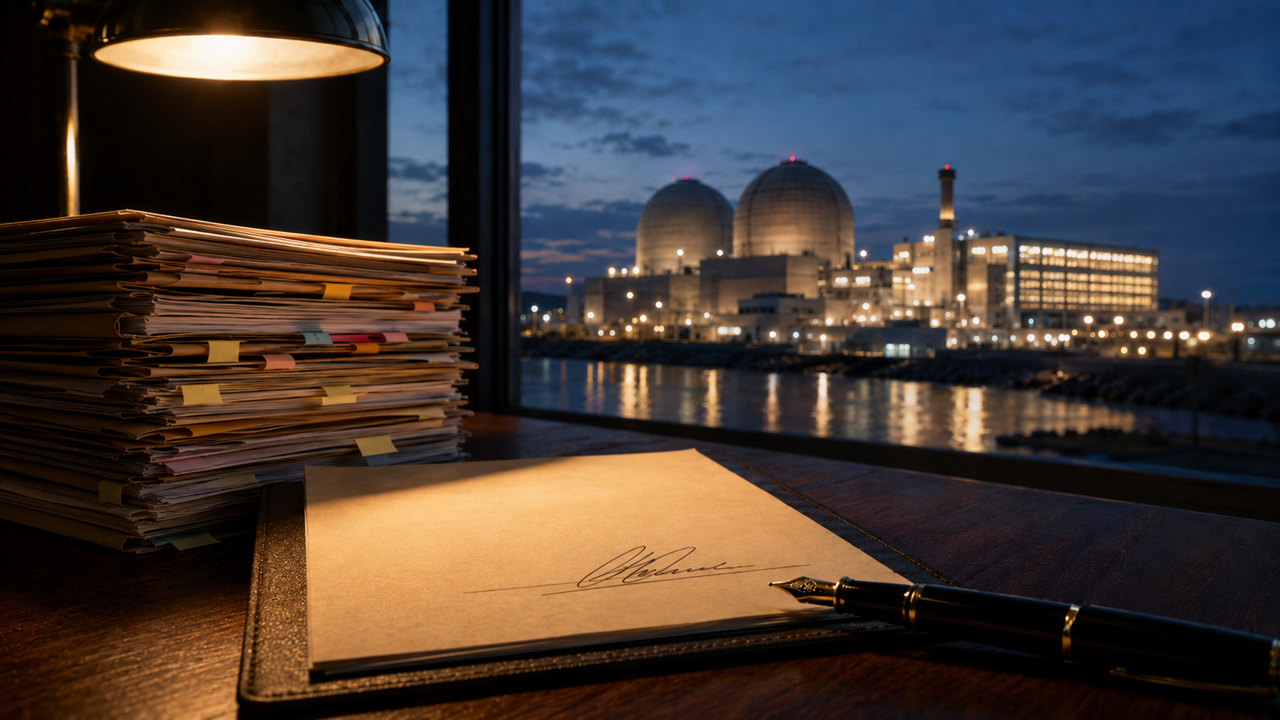
Nuclear plans its schedules around the long lead times of heavy hardware. The longest item on the critical path is often a signature.
Waiting has never appeared in a nuclear cost estimate. It shows up everywhere else. A treaty can sit signed and unusable for more than a decade, and a refurbishment can reach its second phase before the money for the third arrives. None of that is an engineering problem. This week five of those waits ended, and the work they released was already finished.
These waits ran from nine months to more than eleven years. None of the five bodies shares a jurisdiction or an incentive with the others, and none of them consulted the rest. Five separate institutions reaching yes inside the same two weeks usually means the pressure behind all of them is coming from somewhere they have in common. We start with the longest wait.
On July 9, during an official visit by Prime Minister Narendra Modi to Australia, the two governments signed the administrative arrangement that lets Australian uranium ship to India. The cooperation agreement it operates under was signed in 2014 and came into force in November 2015. What sat in between was a list of conditions. Australia's Joint Standing Committee on Treaties wanted India's regulatory regime, its inspection practice and its decommissioning plans settled before any sales began, and Parliament passed a separate Civil Nuclear Transfers bill in November 2016. India is the hard case here. It never signed the Non-Proliferation Treaty and was locked out of the trade until a 2008 safeguards agreement with the IAEA and an exemption from the Nuclear Suppliers Group. Australia produced almost 4,600 tonnes of uranium in 2024 and exports every tonne under bilateral safeguards. India runs 24 reactors, holds very little uranium of its own and wants 100 GW by 2047. The market logic has been obvious for eleven years. Nuclear trade runs on administrative arrangements, and a treaty without one is a statement of intent. [1]
A week later a Spanish regulator answered a question it had already answered once. On July 17 Spain's Nuclear Safety Council issued a conditional favourable report on renewing the operating licence for both units at Almaraz, finding the plant fit to run safely until June 2030. The CSN reached that same date in June 2020, since Spanish licence renewals run ten years. Spain's 2019 phase-out agreement then cut the authorisation back to October 2027 for unit I and a year later for unit II. The operator asked for the full term back last October, and the regulator has worked through its data since February. The report draws on 29 documents from 16 specialist areas inside the CSN, covering the ageing of safety structures, fire protection and whether the plant has anywhere to put its used fuel through 2030. It does. Almaraz supplies more than 7% of Spanish electricity, and its two units will have run 47 and 46 years by 2030. The report now goes to the Ministry for Ecological Transition. The safety case has been settled since 2020, and the only open question was ever political. [2]
The same day, a very different institution signed off at sea. The Korea Research Institute of Ships and Ocean Engineering received Approval in Principle from the American Bureau of Shipping for a 15,000 TEU container ship driven by two small molten salt reactors. ABS is a classification society, and Approval in Principle is an early conceptual gate under its Novel Concept process, confirming that a design meets the intent of the applicable rules subject to conditions. Both reactors sit amidships, where wave loading and collision exposure are lowest, and they share output through an energy storage buffer. Samsung Heavy Industries worked the hull. KAERI is building the marine reactor, under a consortium formed in February 2023. Shipping burns roughly 350 million tonnes of fossil fuel a year and owes the IMO a net-zero fleet by around 2050. A classification society decides what insurers and port authorities will accept, which makes it the approval that governs whether a nuclear merchant ship can ever trade. [3]
The third decision that day involved money, and an institution that has spent years deciding how far it will go. The European Investment Bank approved a EUR800 million loan toward refurbishing Cernavoda unit 1 in Romania. The bank is owned by 27 member states that disagree about nuclear. Its practice has been to fund modernisation and safety work at operating plants and to stay out of new build, which is where this loan sits. The job is a mid-life rebuild, replacing all 480 fuel channels and 960 feeder tubes to buy a Candu-6 its second 30 years. The loan is one layer. Romania is also putting up a EUR600 million grant, state loan guarantees, a 30-year contract for difference and protection against regulatory change, against a project valued at EUR3.2 billion. Four separate mechanisms had to be assembled before a public bank would lend against a reactor that already supplies a tenth of the country's electricity. [4]
The last signal is already in orbit. City Labs launched its Betavoltaic Orbital High-Reliability satellite on July 7 aboard SpaceX Transporter-17, one of 81 payloads on a Falcon 9 rideshare. The power source is a tritium betavoltaic, which converts the beta decay of tritium directly into electricity and shares nothing with a fission reactor except the word nuclear. On this flight the bus runs on conventional solar and the NanoTritium unit powers the payload demonstration, which is the mission. Power that never depends on sunlight is worth having in deep space and in sensor networks nobody will ever service. The regulatory path matters more. BOHR is the first commercial nuclear mission to run the FAA's launch approval pathway under National Security Presidential Memorandum 20, with Sandia National Laboratories independently validating the safety analysis City Labs prepared. The FAA issued its payload authorisation on September 30 last year, nine months before the launch. A pathway used once is a pathway with a precedent, and the next commercial nuclear payload will file into a process that has already produced a yes. [5]
Institutions are slow because slowness is usually free. A regulator that defers a decision pays nothing for the delay, and a bank that declines to lend keeps its money. What changed for all five of these bodies is that somebody else attached a date to the thing they were sitting on. Spain wrote closure dates into a phase-out agreement. The IMO told shipping to reach net zero by around 2050, which is roughly one vessel lifetime away. India set 100 GW against 2047. The cost of waiting became visible, and visible costs are what move institutions.
Each of these decisions also does work for the next one. The FAA has now run its nuclear payload pathway end to end a single time, so the next applicant files into a process with a finished example sitting in it. ABS has written conditions for a molten salt reactor at sea, and those conditions become the starting point for the next design that arrives. Australia and India left a template behind. Other suppliers can read it. A first approval is slow and expensive because it is also the drafting of the rule.
The waits that ended say something about the ones still running. Almaraz is the honest case. The safety finding is complete and the plant's future now sits with a ministry weighing a phase-out it agreed to in 2019, with nothing technical left to resolve. The industry has spent a decade getting very good at producing the evidence that permission requires. It has far less control over what happens once the evidence is filed. That gap is where the schedule lives.
Five institutions with nothing in common finished deliberating inside two weeks. What they released was uranium already mined, a plant already running, a design already drawn and a satellite already built and in orbit. All of it had been ready and waiting on a signature. This week the signatures came.
The industry has become very good at building the case and much less good at shortening the wait that follows it. So here is my question for you: what is sitting finished in your own work right now, waiting on somebody else to sign?
More next week.
Dive deeper
- Australia Agrees to Export Uranium to India India and Australia signed the administrative arrangement enabling Australian uranium exports to India under the cooperation agreement signed in 2014 and in force since November 2015. The announcement came during Prime Minister Narendra Modi's official visit to Australia. Exports proceed for exclusively peaceful purposes under IAEA safeguards. Australia produced almost 4,600 tonnes of uranium in 2024, and India operates 24 reactors against a target of 100 GW by 2047.
- Spanish Regulator Supports Almaraz Licence Extension Spain's Nuclear Safety Council issued a conditional favourable report on renewing the operating licence for both Almaraz units, finding the plant meets the conditions to operate safely until June 2030. The report draws on 29 documents prepared by 16 specialist areas of the regulator and covers ageing management, fire protection and used fuel storage capacity through 2030. Spain's 2019 phase-out agreement currently sets closure for October 2027 and 2028. The report now goes to the Ministry for Ecological Transition for a final decision.
- South Korean SMR-Powered Container Ship Design Certified The Korea Research Institute of Ships and Ocean Engineering received Approval in Principle from the American Bureau of Shipping for the conceptual design of a 15,000 TEU container ship propelled by two small modular molten salt reactors. KRISO and Samsung Heavy Industries handled the hull design and system layout while KAERI develops the marine reactor. Both reactors are placed centrally to limit wave impact and collision risk, with an energy storage system managing surplus output. The consortium behind the work signed its founding memorandum in February 2023.
- European Investment Bank Agrees to Cernavoda Refurb Loan The European Investment Bank approved a EUR800 million loan toward the refurbishment of Cernavoda unit 1 in Romania, part of a EUR3.7 billion package of approvals. The project carries an estimated nominal value of EUR3.2 billion and is supported by a EUR600 million Romanian grant, state guarantees, a 30-year two-way contract for difference and protection against regulatory change. The refurbishment extends the Candu-6 unit to 60 years and replaces all 480 fuel channels and 960 feeder tubes. The bank funds modernisation and safety work at existing plants and does not invest in new nuclear projects.
- First Commercial Nuclear-Powered Satellite Launched City Labs launched its Betavoltaic Orbital High-Reliability satellite aboard SpaceX Transporter-17, the world's first commercial nuclear-powered satellite and first nuclear CubeSat. The payload demonstrates the company's NanoTritium betavoltaic technology as a power source independent of sunlight. BOHR is the first commercial nuclear mission to use the FAA's launch approval pathway under National Security Presidential Memorandum 20, with Sandia National Laboratories validating the launch safety analysis. The FAA issued its payload authorisation on 30 September 2025.
Process note: This brief is created using an AI-assisted workflow and reviewed before publication. Learn more about Finding Critical Path and how each edition is built at About — FindingCriticalPath.com.