
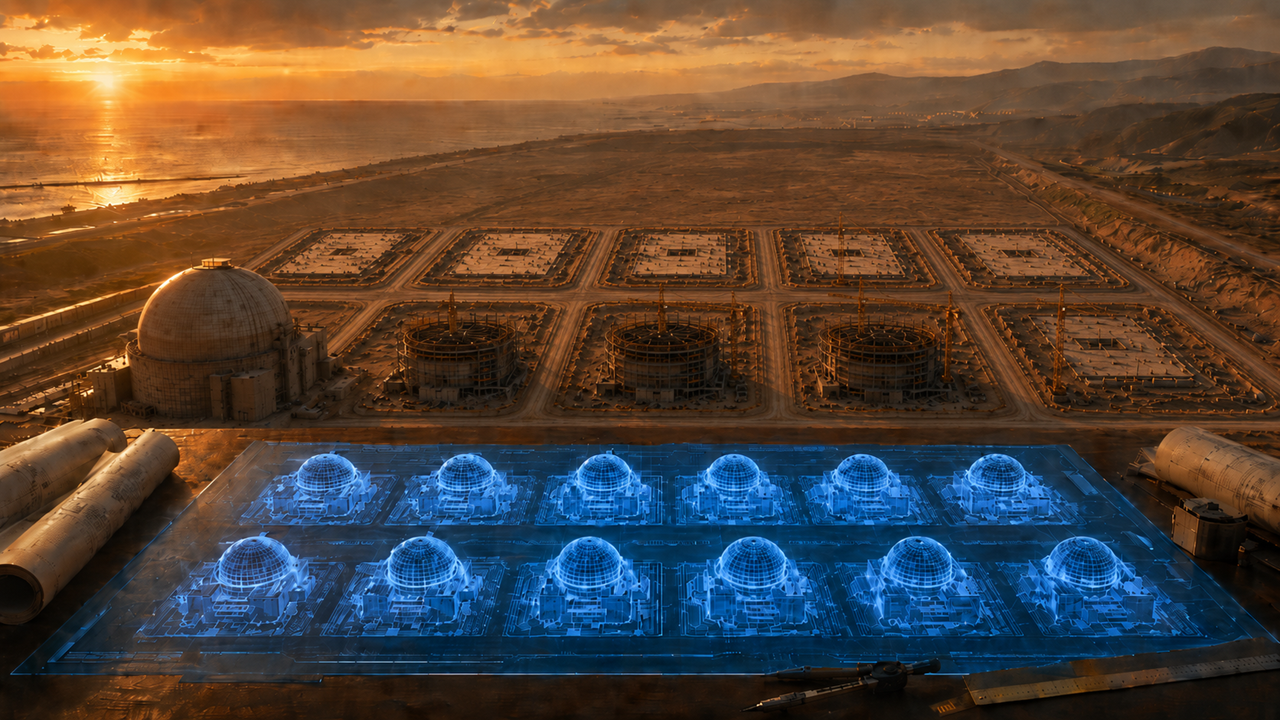
The most reliable thing an industry tells you about its future is the size of the goal it is willing to say out loud. Nuclear just started speaking in fleets.
For most of the last forty years, a country that wanted nuclear announced a plant. One reactor, one site, one number, with the next decision deferred until that one was finished. The goal stayed small because the confidence behind it was cautious. This week the goal got bigger in three different capitals, and the size of the new number is what stops you. When the United States, Canada, and India each commit to ten reactors in the same stretch of days, the ambition stops being a forecast and becomes a plan, with money, policy, and steel already moving to back it. The signals this week show what that larger ambition is buying.
When one government raises its ambition, that is politics. When the same number turns up in the same week inside a loan office in Washington, on a forging floor in India, and within a fusion industry's own assessment of itself, the change is running deeper than any single policy. None of these actors takes its cue from the others. The largest commitment is the one with the most money behind it, so we start there.
On June 23, the Department of Energy issued a conditional loan commitment of 17.5 billion dollars to finance the long-lead components for ten large-scale reactors across the United States. The structure tells you how serious the intent is. The money flows through up to five loans, each backing two AP1000 reactors at a single project site, with Westinghouse paired with a utility or energy company on each one. The partners put up the equity first. Both have to commit 500 million dollars apiece, a billion per project, before any federal money moves. Westinghouse has signed letters of intent with seven potential partners, each with a site already identified. The loans go after the longest-lead items first, the heavy forgings and pressure vessels that take years to manufacture, and the department projects the financing could pull deployment timelines forward by as much as three years. Ten AP1000s at 1.1 gigawatts each is enough power for roughly ten million homes. The reactor count is the headline. The willingness to order the parts before the plants are even sited is the signal underneath it. [1]
The same week, a second government reached the same number through policy. On June 22, Canada's Natural Resources Minister Tim Hodgson unveiled a national strategy to build up to ten new large-scale reactors, with construction on the first two to begin by 2035, five more planned or under development by 2040, and at least one new reactor under construction outside Ontario by 2035. The strategy reaches past the reactors into the fuel that supplies them. It builds on Canada's CANDU technology, its Saskatchewan uranium, and a refurbishment record that just delivered Darlington Unit 4 four months early and 150 million Canadian dollars under budget. Ottawa framed the goal as doubling the country's grid by 2050, and said plainly there is no credible path to that without nuclear. One piece is still missing. The financing details wait on a policy due by April 2027, which is the place Canada's commitment trails Washington's. The stated scale is identical. The mechanism is a year behind. [2]
The third government in the set is already building its ten. On June 23, Nuclear Power Corporation of India unloaded the first End Shield for Kaiga units 5 and 6, a 107-tonne component nearly a metre thick and 9.3 metres across, manufactured by L&T Heavy Engineering at its Hazira facility. The End Shield is the first major piece of the reactor core, providing structural support to the coolant channels and forming part of the calandria vault. Kaiga 5 and 6 are Indian-designed 700 megawatt pressurised heavy water reactors, and they are two of ten that NPCIL is building in what it calls fleet mode. L&T has already delivered four of the eight steam generators for the units. First concrete was poured earlier this year, and the target is criticality within five years. The detail that separates India from the other two is the verb tense. Where Washington and Ottawa are committing to a fleet, India is lowering one into place. [3]
The fleet-scale logic showed up on the demand side too, at a different order of magnitude. Constellation and Walmart signed a long-term power purchase agreement for roughly 176 megawatts from the two-unit Dresden plant in Illinois, including 30 megawatts of new capacity from planned uprates. Walmart buys energy, capacity, and environmental attributes across two fifteen-year terms beginning in 2029 and 2030, with the new power earmarked for a perishable distribution centre under development in Belvidere. It is Walmart's first nuclear PPA and among the first deals of its kind between a major retailer and a nuclear plant. The agreement follows Dresden's twenty-year license renewal in December, which extends the two reactors to 2049 and 2051. A retailer contracting for power on a fifteen-year horizon is doing the same thing the governments are doing from the other end of the market. It is committing far enough ahead to make new capacity worth building. [4]
The last signal comes from the corner of the industry with no fleet to point to yet, and it is moving toward the same posture. The Fusion Industry Association reported that supply chain spending across the fusion sector rose 25 percent to 538 million dollars in 2025, drawn from interviews with 25 fusion companies and 67 suppliers. More than two-thirds of fusion companies say established suppliers are pivoting toward fusion, and 75 percent of suppliers made investments to expand their fusion capacity over the year. The gridlock the report has tracked in past years, suppliers unwilling to invest without demand and developers unable to generate demand without supply, is starting to loosen. The bottlenecks named are power systems, heat management, and vacuum vessels, with fuel-cycle systems flagged as the top future concern, and 69 percent of suppliers still report a lack of long-term demand visibility. The report's own recommendation is the tell. It asks developers to issue clearer demand signals through long-term agreements and forward purchasing, which is fusion asking for exactly the kind of committed-ahead demand that fission demonstrated three times over this week. [5]
Capability has not been nuclear's constraint for a while. The reactors work, the fuel forms are proven, the supply chains exist or can be rebuilt. What held the industry back was nerve, the willingness to state a goal large enough to justify the machinery that meets it. A sector that commits to one reactor orders parts for one reactor. A sector that commits to ten orders differently, finances differently, and asks its suppliers to tool up for a production run. The work stops being a one-off job.
That is the shift the week records. The DOE loan is sized for ten reactors because someone decided to aim at ten. Canada's strategy reaches into uranium and refurbishment because the goal is a whole program with a reactor count attached. India is forging End Shields in fleet mode because it set the target years ago and is now far enough in to be lifting the hardware. Even the demand side and the fusion supply chain are organizing around the same idea, that a commitment stated at scale and far enough ahead is what lets everyone underneath it build with confidence.
The reactor counts will move around. Loans carry conditions, strategies await their financing, components face the long road from a heavy-engineering floor to a critical core. What changed this week is harder to walk back than any single number. Three governments said ten out loud, and a market and a frontier technology started arranging themselves around goals that size. An industry that raises its own ceiling tends to discover it can reach it.
For forty years nuclear told the world it wanted a reactor. This week it said it wants a fleet, three times, in three countries, with the money and the steel already in motion. The goal an industry is willing to name is the first measure of what it will build. Nuclear just named a bigger one.
The size of the goal turned out to be the thing holding nuclear back, more than any reactor design or supply chain gap. So here is my question for you: in your own corner of this work, what would you commit to if you let the ambition match the capability you already have?
More next week.
Dive deeper
- Department of Energy Announces American Nuclear Supply Chain Loans The Department of Energy issued a conditional loan commitment of 17.5 billion dollars to finance long-lead components for ten large-scale AP1000 reactors across the United States. The financing flows through up to five loans, each backing two reactors at a project site jointly owned by Westinghouse and a utility or energy partner, with both partners required to commit 500 million dollars in equity per project before federal funds are released. The department projects the structure could accelerate deployment timelines by up to three years.
- Canada Announces Strategy For 10 New Large-Scale Nuclear Reactors Canada unveiled a national strategy to build up to ten new large-scale reactors, with construction on the first two to begin by 2035 and five more planned or under development by 2040. The strategy extends into uranium development and refurbishment and aims to support a doubling of the country's electrical grid by 2050. Financing conditions and tools are to be set out in a policy due by April 2027.
- Major Component Milestone for Indian Reactor Nuclear Power Corporation of India unloaded the first End Shield for Kaiga units 5 and 6, a 107-tonne core component manufactured by L&T Heavy Engineering at Hazira. The End Shield is the first major piece of the reactor core. Kaiga 5 and 6 are Indian-designed 700 MW pressurised heavy water reactors, two of ten NPCIL is building in fleet mode, with first criticality targeted within five years.
- Constellation and Walmart Announce Long-Term PPA From Dresden Nuclear Plant Constellation and Walmart signed a long-term power purchase agreement for roughly 176 MW from the Dresden plant in Illinois, including 30 MW of new capacity from planned uprates. Walmart will purchase energy, capacity, and environmental attributes across two fifteen-year terms beginning in 2029 and 2030. It is Walmart's first nuclear PPA and among the first such agreements between a major retailer and a nuclear facility, following Dresden's twenty-year license renewal in December 2025.
- Fusion Supply Chain Spend Up, But Challenges Remain The Fusion Industry Association reported that fusion supply chain spending rose 25 percent to 538 million dollars in 2025, based on interviews with 25 fusion companies and 67 suppliers. More than two-thirds of companies report established suppliers pivoting to fusion and 75 percent of suppliers invested to expand fusion capacity, though 69 percent still cite a lack of long-term demand visibility. The report calls for developers to issue clearer demand signals through long-term agreements and forward purchasing.
Process note: This brief is created using an AI-assisted workflow and reviewed before publication. Learn more about Finding Critical Path and how each edition is built at About — FindingCriticalPath.com.