
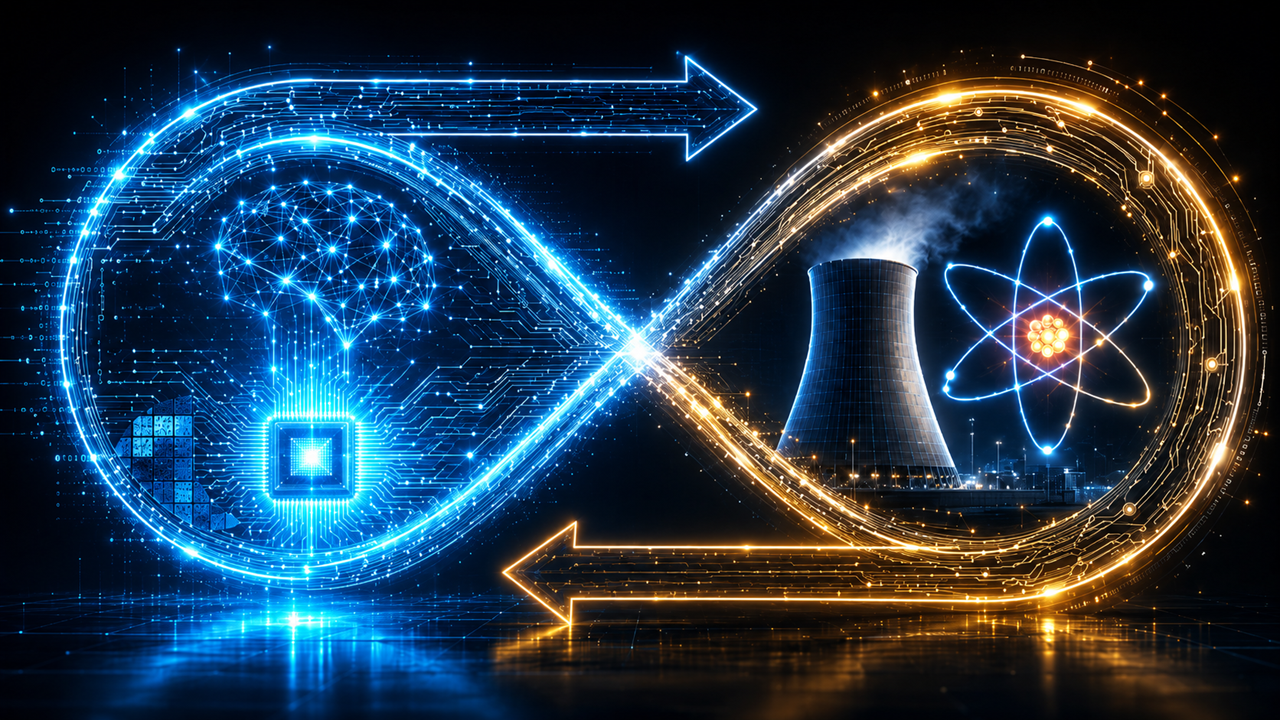
AI needs more electricity than the grid can give it. Nuclear can make that energy, but needs AI to build fast enough to matter. The two were always meant to power each other.
There is a catch in that tidy arrangement. Nuclear has always been slow to build, and AI is the least patient customer the power business has ever had. A pairing like that only works if reactors can go up on a schedule the industry has never once managed to hit. What changed is who forces the pace. The buyers stopped waiting for nuclear to fix its own speed and started paying to accelerate it themselves.
These five cohere for one reason. Several of the companies pulling the new demand are the same ones partnered inside the federal effort to build reactors faster. When the cast creating the demand is also the cast building the answer, the week stops being a theme and becomes a closed circuit. We start with the cleanest instance of it, an AI company that arranged for its own reactor.
The clearest version came from Aalo Atomics and Crusoe, which agreed to put an advanced reactor to work powering an AI data center. Aalo will run a Crusoe Spark data center at Idaho National Laboratory in 2027 as a proof of concept, then place its 50-MWe Aalo Pods at Crusoe sites by the end of 2029. Each Pod packs five 10-MWe reactors onto a shared turbine and under five acres, factory-built to match how fast a data campus grows. A second Aalo reactor is already under construction at INL to power a data center directly. Its zero-power test reactor reached criticality there on July 4, one of four advanced units to get there within about a month. The tell is sequence. A reactor developer now has a named, contracted customer before its design has even run at full power. That reverses the order the industry has always worked in, where the machine proved itself first and buyers came after. [1]
The same pull reaches all the way to the frontier. Commonwealth Fusion Systems raised $1 billion, the largest single round the fusion sector has seen, bringing its total to $4 billion, close to a third of all the capital fusion has ever attracted. The backers include pension funds and sovereign wealth funds, the kind of patient money that appears when a technology starts to look bankable. The raise funds its Sparc demonstration machine, due to reach first plasma this year, and its 400-MW Arc plant in Chesterfield County, Virginia, targeted for the early 2030s. Two facts matter more than the money. Google has already agreed to buy the plant's power, and CFS has applied to PJM for a grid connection, the first time a fusion developer has asked to join a major grid operator. A machine that will not produce electricity for years already has a named buyer and a place in the interconnection queue. That is fusion treated as a generator with a delivery date, not a laboratory bet. [2]
The capital is moving even where the customer is not an AI company at all. Antares Nuclear raised $470 million, $370 million in equity and $100 million in debt, to build microreactors for US military bases. The round was led by Paradigm and Caffeinated Capital, and the company tied investor interest directly to the AI data center boom and the hunt for reliable low-carbon power. Antares is one of three finalists in the Pentagon's program to test small reactors on Air Force bases in Colorado and Montana, with a first electricity-producing unit due next year and base deployments in 2028. It is a fast climb for a company that raised $96 million as recently as December. The reactors are for the military. The money is priced on AI's appetite. When demand from one sector sets the cost of capital for reactors headed to another, the AI pull has stopped being about any single data center and become the sector's financing weather. [3]
Behind these deals sits a grid rule that helps explain them. PJM, the largest US grid operator, moved to require that new data centers and other large loads either bring their own power or face curtailment when the system nears emergency conditions. Loads that do not supply themselves will be pulled from the demand forecasts that set future capacity auctions, so existing customers stop paying for them. The curtailment framework would take effect next June. The board also proposed a one-time backstop auction to cover a 6.8-GW shortfall from its last capacity sale. PJM expects large load to grow by as much as 70 GW by 2038. The message is blunt. A data center that wants to plug in is now steered toward bringing its own generation, the exact opening on-site reactors are built to fill. [4]
The loop closes with the industry turning AI back on itself. The Idaho National Laboratory-led Prometheus project won a $60 million federal award, the largest single investment among the 278 projects picked under the Genesis Mission. That program, the government's push to embed AI across national research, drew the largest response to a funding call in the Department of Energy's history. Prometheus brings together 32 partners to apply AI across the full reactor lifecycle, from design and licensing to construction and operation, keeping humans in the loop, with the stated aim of cutting deployment timelines and operating costs in half. The team has already put in more than $200 million of its own cost share and $30 million in capital. Look at who the partners are. Aalo, Antares, Oklo, and Westinghouse sit inside Prometheus alongside Nvidia and Amazon, the same firms drawing the demand now building the tools to meet it faster. The speed problem that made this whole pairing precarious is the exact thing the industry has aimed its newest instrument at. [5]
None of this guarantees nuclear wins. In the same stretch, a $100 billion data center campus at a former enrichment site in Kentucky was invited to include reactors and chose gas and batteries instead. Speed and cost still decide these contests, and nuclear has lost them for decades. What makes this moment different is where the pressure now points. The demand that exposes nuclear's one disqualifying weakness, its pace, is the same demand paying to remove it. Buyers are funding reactors, contracting for their output before first power, and joining the AI effort built to halve the time it takes to license and build one. Nvidia and the Idaho lab call it a virtuous cycle, AI speeding the reactor and the reactor feeding the AI, and for once the phrase is doing real work. The whole story sits in the United States for now, a function of where the compute and the capital are concentrated. What changes in practice is how the next reactors get specified. They are sized to a single buyer's load and financed on that buyer's schedule, with the grid inheriting whatever spills over.
So the reactor and the algorithm are being built on the same schedule now, by many of the same companies. That is new. And it is the strongest reason yet to believe nuclear will move at the speed it has always been asked to.
Can this loop form anywhere that compute and capital are not already concentrated, or is that pairing the one thing a country cannot bootstrap its way into?
More next week.
Dive deeper
- Aalo and Crusoe to Pair an Advanced Reactor with an AI Data Center at Idaho National Laboratory Advanced nuclear firm Aalo Atomics and AI infrastructure company Crusoe formed a partnership to build a nuclear-powered AI data center. Aalo will power a Crusoe Spark modular data center at Idaho National Laboratory in 2027 as a proof of concept, then deploy its 50-MWe Aalo Pods at Crusoe data centers by the end of 2029. Each Pod uses five 10-MWe reactors on a shared turbine. Aalo's Critical Test Reactor, a zero-power physics unit, reached criticality at INL on July 4, one of four advanced reactors to do so within about a month, and work has begun on a second, 10-MWe reactor meant to power an on-site data center.
- Commonwealth Fusion Systems Raises $1 Billion, the Fusion Sector's Largest Round Commonwealth Fusion Systems raised $1 billion, the largest single funding round in the fusion sector, bringing its total to $4 billion, about 30 percent of all capital raised by the fusion industry to date. Backers include pension funds, sovereign wealth funds, and industrial partners. The company will fund its Sparc demonstration machine, expected to reach first plasma this year, and its 400-MW Arc plant at the Fall Line Fusion Power Station in Chesterfield County, Virginia, targeted for the early 2030s. CFS has applied to grid operator PJM for connection, the first fusion developer to do so, and Google has agreed to buy power from the Fall Line plant.
- Antares Raises $470 Million to Build Microreactors for Military Bases Antares Nuclear raised $470 million to build microreactors for US military bases, in a Series C led by Paradigm and Caffeinated Capital with participation from Point72 Ventures, Industrious Ventures, and Shine Capital. The round comprised $370 million in equity and $100 million in debt, and the company tied investor interest to the AI data center boom and demand for reliable low-carbon power. Antares is one of three finalists in the Pentagon's Advanced Nuclear Power for Installations program, which will test reactors on Air Force bases in Colorado and Montana. It aims to bring its first electricity-producing reactor online next year, with base deployments in 2028. The company raised $96 million in December.
- PJM Moves to Make Large Loads Bring Their Own Power PJM's board proposed requiring new data centers and other large loads to bring their own power or face curtailment when the grid nears emergency conditions, and to exclude loads that do not supply themselves from the demand forecasts that set future capacity auctions. The board also proposed a one-time backstop auction, starting in September, to cover a 6.8-GW shortfall from its last capacity sale, with a cost cap raised to $555 per MW-day. PJM expects large load across its footprint to grow by as much as 70 GW by 2038. The proposals go to the Federal Energy Regulatory Commission for review.
- Prometheus Wins the Largest Genesis Mission Award to Accelerate Nuclear with AI The Idaho National Laboratory-led Prometheus project was selected for a $60 million federal investment over three years, the largest single award among 278 projects chosen under the DOE Genesis Mission, which drew the largest response to a funding call in the department's history. Prometheus is a 32-partner collaboration including national labs, universities, and industry partners such as Aalo Atomics, Antares, Oklo, Westinghouse, X-energy, Nvidia, and Amazon Web Services. It will apply AI across the full reactor lifecycle, from design and licensing to construction and operation, with human-in-the-loop workflows, aiming to cut deployment timelines and operating costs in half. The team has raised more than $200 million in industry cost share and $30 million in capital.
Process note: This brief is created using an AI-assisted workflow and reviewed before publication. Learn more about Finding Critical Path and how each edition is built at About — FindingCriticalPath.com.