
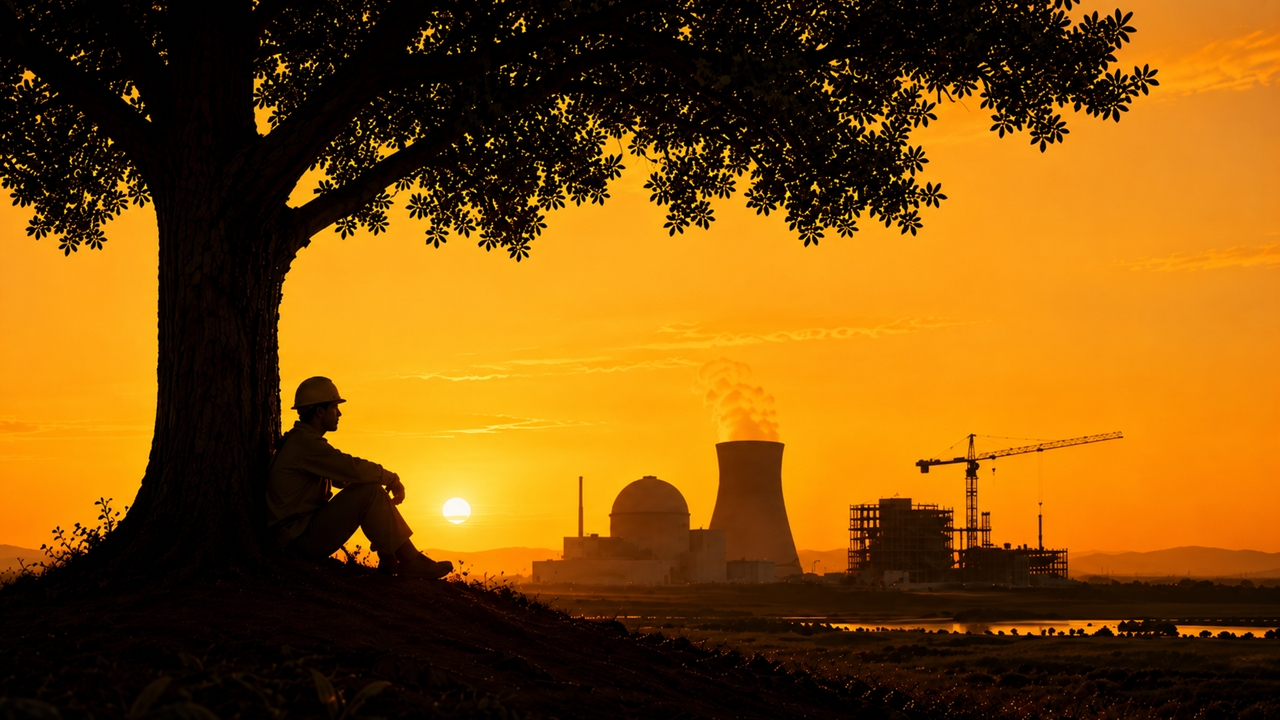
A mentor of mine retired today, after decades spent as one of the nuclear industry's leading innovators. The fleet running today is like the forty- and fifty-year-old trees that people like him planted and tended through the first era of nuclear power. This week, the industry was busy planting the next ones.
The signals this week sort themselves across three generations of work. Some of them keep the current fleet running, the reactors his generation built and proved out. Some are the next generation taking shape now, going up where this decade's power will come from. And some are seeds for the generation of nuclear technology still ahead of us, the work that will define what the industry looks like long after the current buildout is finished. An industry tends all three at once when it is confident about every stage of its own future.
What stands out this week is how many stages of nuclear deployment are advancing at once. The signals run from reactors already on the grid to a technology the industry is still building toward. The nearest of them has been generating for a decade.
Argentina's Nuclear Regulatory Authority has granted Atucha-2 a new ten-year operating license, clearing the reactor to run until 2036. Atucha-2 began commercial operation in 2016 and sits about a hundred kilometers from Buenos Aires, one of three units that together supplied 7.4 percent of the country's electricity in 2024. A renewal like this is the least dramatic kind of nuclear news, and that is part of why it matters. Keeping an operating reactor in service is the foundation everything else depends on. The operator framed the new license as consolidating the plant's strategic role in the national grid, which is another way of saying Argentina intends to keep counting on this reactor well into the next decade. [1]
The work of sustaining today's fleet reaches past the reactors themselves. Ukraine's nuclear regulator has issued Energoatom a full operating license for its Centralised Spent Nuclear Fuel Storage Facility in the Chernobyl Exclusion Zone, the dry storage site that holds used fuel from the country's reactors. The facility had been operating under a commissioning license since it began receiving fuel in late 2023. The full license is the formal confirmation that Ukraine can now manage its own spent fuel on its own soil. Before the facility existed, that fuel was shipped to Russia for storage at a cost the operator puts at around two hundred million dollars a year. Spent fuel management is the part of the lifecycle that earns no headlines and carries no glamour, and a reactor cannot keep running without it. [2]
The next of the week's signals moves from the fleet that exists to the fleet still going up. In South Korea, the first concrete has been poured for the reactor building at Shin Hanul Unit 4, the formal start of construction. It is an APR1400, the same large reactor design Korea has built at home and exported to the UAE, and it is targeted for completion in 2033. Together with its sister unit next door, it is expected to supply close to half the electricity demand of the surrounding Gyeongbuk region. This is the generation of reactors that will carry the load through the 2030s, being built now so the power is there when it is needed. [3]
The week's last two signals belong to a generation of technology that is still being built toward. Thea Energy, a New Jersey company developing a stellarator approach to fusion, has raised one hundred million dollars in Series B funding, months after the Department of Energy certified its power plant design concept. The round will expand its magnet manufacturing, including a second facility, and move it toward siting its first large-scale integrated stellarator later this year. Thea's design swaps the famously intricate magnets of a traditional stellarator for flatter, software-controlled ones, a bet that fusion becomes commercial once it becomes manufacturable. A hundred million dollars does not finish fusion. It funds another serious push toward it, and capital arriving at that scale tells you private investors are starting to treat the technology as something buildable. [4]
The other fusion signal has been decades in the making and will support fusion for decades to come. ITER, the thirty-five-nation tokamak under construction in southern France, has brought its Magnet Cold Test Facility into operation, cooling its first toroidal field coil to four kelvin. The coil is a three-hundred-thirty-tonne piece of superconducting magnet, and the facility exists to test coils like it at full operating conditions before they are installed in the machine. Each coil takes four to six months to work through. The point of the facility is to find problems on a test stand instead of inside a half-built reactor. What makes it matter beyond ITER itself is that the organization plans to open the facility to private fusion companies once its own coils are tested. The largest public fusion project in the world is building infrastructure that the newest private ventures will be able to use. [5]
An industry reveals what it believes about its own future by how far ahead it is willing to spend. Spending on the reactors running today is survival. Any sector protects the assets it already has. Putting real capital and real years into fusion is a different kind of act. The payoff belongs to people who are not in the industry yet, the engineers and operators who will inherit these machines the way this generation inherited the fleet the last one built.
That is what the two fusion signals are. Thea's hundred million and ITER's first cooled coil are the same horizon seen from two directions, the money and the metal of a technology that will not carry load for years. Neither is a bet on a return anyone can collect soon. They are seeds, planted now by people who understand they are growing something the next generation will be the ones to use. A private company expanding a magnet factory and a thirty-five-nation consortium cooling a coil to four kelvin are doing the same thing the first era of nuclear did when it built the plants still running today. They are putting work into the ground for a harvest that arrives later.
A sector commits that far ahead only when it is sure it will still be standing to use what it builds. That confidence is the signal. You plant the tree knowing someone else will sit in its shade.
The fleet running today was started by people who knew what they were building would far outlast their careers. It became the foundation everything now stands on. The work this week reaches further out, toward machines whose operators are not yet trained. Some are not yet born. The industry is planting anyway.
The work started decades ago is still running. The work funded this week will not pay off for decades more. What lessons learned in the industry's first fifty years carry forward to secure the next fifty, and the fifty after that?
More next week.
Dive deeper
- Argentina's Regulator Grants New 10-Year Operating Licence For Atucha-2 Argentina's Nuclear Regulatory Authority has granted a new ten-year operating license for the Atucha-2 nuclear power unit, enabling its operation until 2036. The state-owned operator said the renewal consolidates the plant's strategic role within the national electricity system.
- Energoatom gets operating licence for centralised fuel storage facility Ukraine's State Nuclear Regulatory Inspectorate has issued Energoatom a full operating license for its Centralised Spent Nuclear Fuel Storage Facility in the Chernobyl Exclusion Zone. The dry storage site holds used fuel from the country's reactors and ends the need to ship spent fuel to Russia for storage.
- Construction starts for Shin Hanul 4 First concrete has been poured for the reactor building of South Korea's Shin Hanul Unit 4, an APR1400 targeted for completion in 2033. Together with unit 3, it is expected to supply close to half the power demand of the Gyeongbuk region.
- Thea Energy Raises $100 Million in New Funding to Advance Fusion Technology New Jersey-based Thea Energy raised $100 million in Series B funding to advance its planar-coil stellarator approach to fusion. The round will expand magnet manufacturing and move the company toward siting its first large-scale integrated stellarator later this year.
- ITER magnet test facility begins operation The ITER Organization has brought its Magnet Cold Test Facility into operation, cooling its first toroidal field coil to four kelvin. The facility tests superconducting magnets at full operating conditions before installation and will later be opened to private fusion companies.
Process note: This brief is created using an AI-assisted workflow and reviewed before publication. Learn more about Finding Critical Path and how each edition is built at About — FindingCriticalPath.com.