
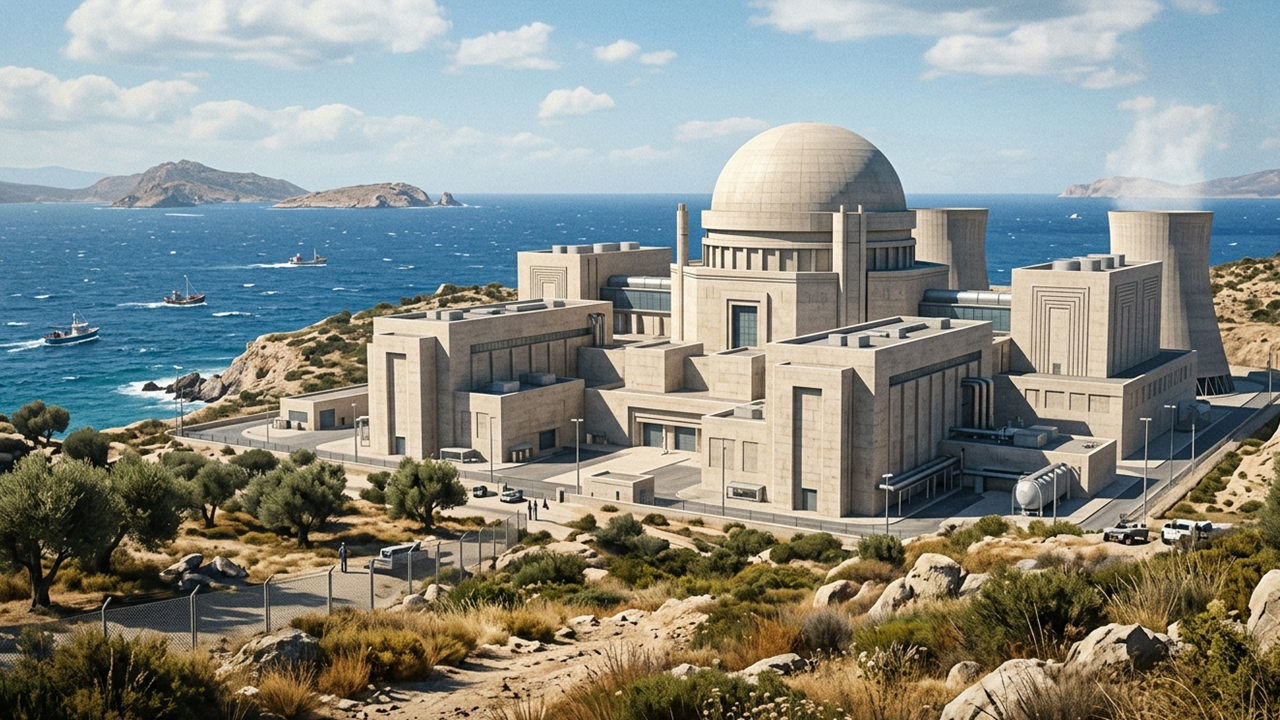
Nuclear is not just trying to move faster. It is starting to think further ahead.
In recent weeks, the signals pointed toward a more buildable nuclear future. Regulatory pathways were improving. Fuel systems were starting to align. Industrial foundations were strengthening. Serious commitments were beginning to replace abstract ambition. This week suggests another step forward. The industry is not only trying to move projects ahead. It is investing in the conditions that allow nuclear systems to endure.
This week's signals point to an industry investing in durability.
In Texas, production has begun at Uranium Energy Corp's Burke Hollow project, the first new in-situ recovery uranium operation to start up in the United States in more than a decade. Production from the site will be processed at the company's Hobson Central Processing Plant, which is licensed for up to 4 million pounds of uranium per year. Upstream capacity like this matters because durability starts with fuel. A long-lived nuclear future depends on supply systems that can support it [1].
At Idaho National Laboratory, the DOME microreactor test bed is now complete. DOE describes it as a first-of-its-kind facility designed to enable the rapid development, testing, and demonstration of privately developed advanced reactors. Test infrastructure like this does more than accelerate one project. It creates a proving ground where future designs can generate evidence, reduce uncertainty, and move toward deployment on a stronger foundation [2].
In the United States, durability is also showing up at the back end of the lifecycle. Deep Isolation was selected for new ARPA-E support under the SCALEUP Ready program, with funding intended to enable full-scale field testing of its Universal Canister System and a commercial pilot for deep borehole disposal in Texas. The company says the system is designed to accommodate a range of advanced reactor waste streams, while Westinghouse plans to use it as part of spent fuel handling for its eVinci microreactor. Nuclear's staying power is not just a question of what gets built. It also depends on whether the industry can manage waste in ways that are scalable, permanent, and commercially usable [3].
In China, construction has begun on the second unit at the Jinqimen nuclear power plant. The site is planned to eventually house six Hualong One units with total installed capacity of about 7.2 GWe and expected annual output of roughly 55 TWh. This is what long-horizon infrastructure looks like in physical form. Not a single reactor, but a multi-unit platform built around repetition, capacity, and decades of expected operation [4].
The NRC has also received Westinghouse's application to renew and update the AP1000 design certification by incorporating construction and operating experience from Vogtle Units 3 and 4. According to the NRC, the submittal seeks to align the certified design with the as-built Vogtle configuration and could facilitate streamlined licensing, lower regulatory uncertainty and costs, and increased deployment. This is durability expressed through standardization. The more future projects can build from a validated baseline rather than relearning old lessons, the more repeatable nuclear deployment becomes [5].
Durability in nuclear is often discussed as if it were a property of the reactor itself. This week points to a broader reality. Long-lived nuclear systems depend on much more than plant design. They depend on upstream fuel availability, places to test and validate new technologies, credible solutions for spent fuel and waste, standardized designs that reduce friction in future builds, and construction programs large enough to turn institutional learning into lasting infrastructure. The signal this week is that more of those layers are beginning to move together. That does not guarantee success, but it does suggest the industry is thinking more seriously about what it takes to make nuclear expansion hold.
Over the past month, the focus has been on making nuclear more buildable. Regulatory pathways were adapting. Fuel systems were beginning to align. Industrial capacity was strengthening. Public and private institutions were making more serious commitments. This week extends that arc in a useful way. It suggests the conversation is starting to move beyond whether nuclear can advance and toward whether the full system around it is being built to endure. That is a different kind of progress. It's the early signs of an industry thinking more deliberately about how progress holds over time.
Large infrastructure systems matter when they persist. Nuclear has often been discussed in terms of breakthrough, revival, or momentum. This week's signals point to something steadier and potentially more important. Nuclear is building to last.
If nuclear is building to last, how should the industry think about the existing fleet as part of that long-term foundation?
More next week.
Dive deeper
- Production begins at US uranium project Uranium Energy Corp's Burke Hollow project in Texas has begun production, becoming the first new U.S. in-situ recovery uranium operation to start up in more than a decade. Output will be processed at the Hobson Central Processing Plant, strengthening domestic upstream fuel capacity.
- World's First Microreactor Test Bed Now Open for Business DOE announced completion of the DOME facility at Idaho National Laboratory, describing it as a first-of-its-kind site for rapid development, testing, and demonstration of privately developed advanced reactors.
- Deep Isolation selected for new US federal support Deep Isolation was selected for ARPA-E SCALEUP Ready support to advance full-scale field testing of its Universal Canister System and demonstrate deep borehole disposal through a nonradioactive commercial pilot in Texas.
- Construction of second Jinqimen unit begins First safety-related concrete has been poured for unit 2 at China's Jinqimen plant. The site is planned to eventually house six Hualong One units with total installed capacity of about 7.2 GWe.
- NRC Receives Westinghouse Application to Update AP1000 Design Certification The NRC has received Westinghouse's application to renew and update the AP1000 design certification using lessons from Vogtle Units 3 and 4. The agency says the updated baseline could support more streamlined licensing, lower uncertainty and costs, and increased deployment.
Process note: This brief is created using an AI-assisted workflow and reviewed before publication. Learn more about Finding Critical Path and how each edition is built at About — FindingCriticalPath.com.