
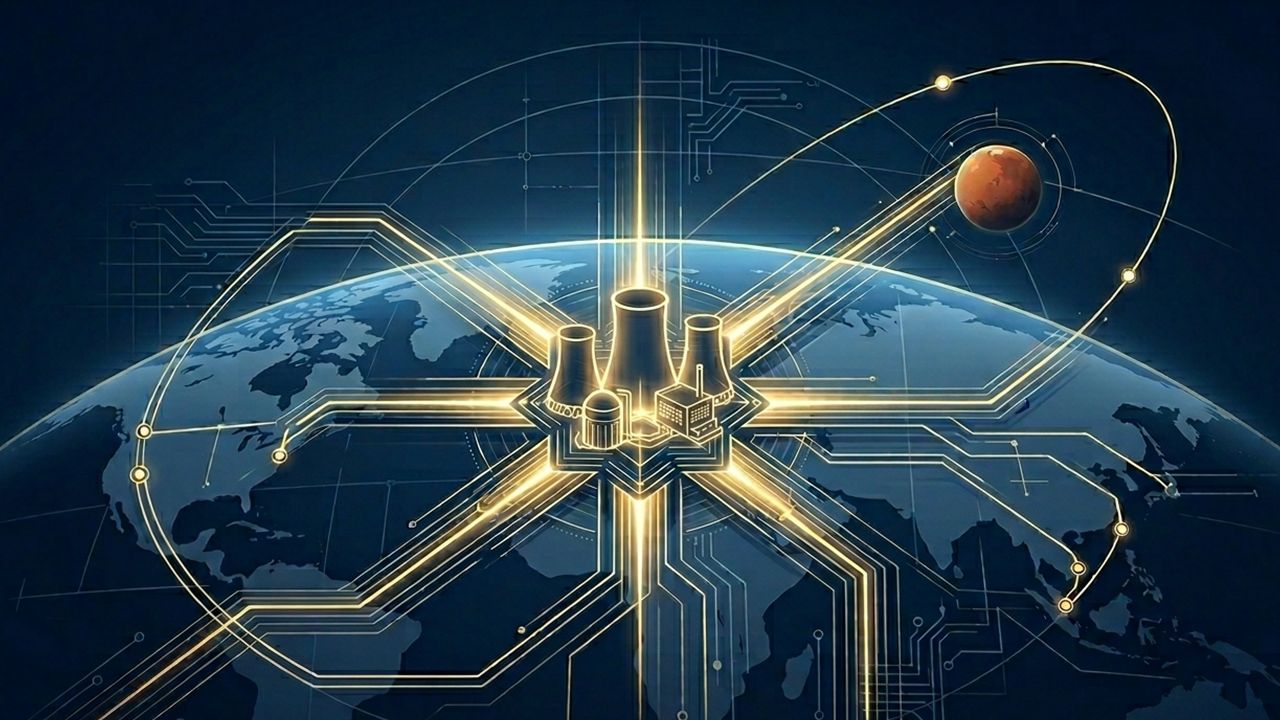
Nuclear is back to building the future.
For much of the past decade, the industry focused on preserving existing capacity, extending operating lifetimes, and modernizing regulatory pathways. Those efforts were necessary. They stabilized the foundation. This week’s signals suggest nuclear is expanding into new territory again.
This week’s signals suggest nuclear is expanding into new territory again.
In the United States, FluxPoint Energy announced plans to build the first new uranium conversion plant in nearly seventy years. Conversion sits at the center of the fuel cycle. Expanding domestic capability restores control over a critical processing step that supports both existing reactors and future deployment programs. Midstream infrastructure returning after decades of absence points to preparation for a long horizon of activity [1].
Regulatory institutions are moving in parallel. The Nuclear Regulatory Commission introduced its first new reactor licensing framework in decades. Process redesign at this scale signals preparation for a wave of new designs. Institutions change procedures when they anticipate sustained demand rather than isolated applications [2].
New nuclear programs are advancing internationally as well. Russia’s agreement to construct the Ninh Thuan 1 plant in Vietnam marks a significant step in establishing nuclear capacity in a country that has not previously operated a commercial reactor fleet. First-of-a-kind national programs shape energy systems for generations [3].
Elsewhere, existing reactors are returning to the conversation. Taiwan’s application to restart the Maanshan plant shows how previously retired capacity is being reconsidered as strategic infrastructure rather than permanent legacy assets. Restarting a reactor can be faster than building a new one. In energy systems under pressure, flexibility matters [4].
Even beyond Earth’s grid, nuclear remains central to future energy systems. NASA’s plans for nuclear propulsion in a Mars mission reinforce a longstanding pattern. When missions move beyond the reach of conventional energy sources, nuclear becomes the enabling technology [5].
These signals span different layers of the nuclear ecosystem: fuel processing, licensing frameworks, first national deployments, fleet restarts, and even space propulsion. They are not connected by geography or technology type. They are connected by direction. Nuclear is moving outward again.
In recent weeks, signals pointed to regulatory reform, fuel alignment, industrial capacity formation, and the financial structures needed to support deployment. Those developments improved the conditions required to build. This week’s articles show the industry is beginning to define where it intends to build next.
Infrastructure sectors spend long periods stabilizing themselves before expanding into new domains. Large infrastructure systems rarely expand all at once. When that expansion begins, it often appears first at the edges and signals an industry is preparing to operate in a larger role than it held before.
For years, nuclear’s role was defined by maintaining what already existed. This week suggests nuclear is back to building the future.
If nuclear is once again shaping the systems that come next, where will its next frontier appear first?
More next week.
Dive deeper
- FluxPoint Energy Enters Race to Build First New U.S. Uranium Conversion Plant in Nearly 70 Years FluxPoint Energy has announced plans to build the first new uranium conversion plant in the United States in nearly 70 years. This move aims to strengthen domestic uranium processing capabilities and reduce reliance on foreign sources. The company is positioning itself to address supply chain challenges in the nuclear fuel cycle.
- NRC Unveils First New Reactor Licensing Process in Decades to Speed Deployment While Maintaining Safety The Nuclear Regulatory Commission announced a new reactor licensing process designed to accelerate the deployment of nuclear reactors while upholding stringent safety standards. This is the first update in decades intended to streamline approvals and support innovation in the nuclear energy sector.
- Russia And Vietnam Sign Agreement To Build Ninh Thuan 1 Nuclear Plant Russia and Vietnam have signed an agreement to build the Ninh Thuan 1 nuclear power plant in Vietnam. This marks a significant step in Vietnam's nuclear energy development, with Russia playing a key role in the project’s construction.
- Taipower applies to restart Maanshan plant Taiwan Power Company has submitted an application to restart the Maanshan nuclear power plant. The move marks a significant step toward resuming operations at the plant, which has been offline. The restart application is part of Taiwan's efforts to enhance its energy security and nuclear power utilization.
- NASA aims for nuclear-powered Mars mission in 2028 NASA plans to use nuclear power for its Mars mission targeted for 2028, aiming to leverage nuclear technology to support long-duration space exploration. This initiative highlights the agency's commitment to advanced nuclear propulsion and power systems for deep space missions.
Process note: This brief is created using an AI-assisted workflow and reviewed before publication. Learn more about Finding Critical Path and how each edition is built at About — FindingCriticalPath.com.